Organic mattresses · Materials · Buying guidance
What Makes an Organic Sleep Surface? Materials, Certifications, and Construction
An organic mattress is not defined by a single ingredient or a reassuring label. It is a layered object: fibres, foams, springs, fabrics and finishes assembled to support a body through the night. To understand what “organic” means in practice, look beneath the cover—at the materials, the claims that have been independently verified, and the way the whole surface is built.
Published 18 October 2026
At first glance, a mattress seems simple: a broad, quiet landscape waiting at the end of the day. Yet its surface may contain a small ecosystem of materials. Cotton can form the cover; wool may regulate warmth and wick moisture; latex can provide buoyant pressure relief; and a steel coil unit can give the bed its underlying structure. In a conventional mattress, synthetic foams, adhesives and chemical finishes may also play a role. In an organic sleep surface, the aim is to make choices about these components more visible—and, where possible, to substantiate them.
That aim deserves careful interpretation. “Organic” is not a synonym for chemical-free, universally natural, or automatically better for every sleeper. It may refer to a particular fibre, such as certified organic cotton, rather than the entire mattress. Even when several materials are certified, the finished product’s construction, comfort and durability still matter. The most useful question is not simply whether a mattress is organic, but what that claim covers and how it is supported.
This guide offers a practical way to read material descriptions, certification information and construction details. It also sets out a neutral comparison framework for products from brands such as Obasan and Naturepedic, without treating a brand name as a substitute for checking the specifications of an individual model.
Start with the layers, not the label
A mattress is a system. Its uppermost fabric is in close contact with bedding and skin; the comfort layers influence how the body settles; and the support core bears much of the load. These layers work together, so a material’s qualities cannot be judged in isolation. A breathable cover, for example, may not make a mattress feel cool if the layers beneath it retain heat. A resilient core may provide support, but still feel too firm if the comfort layers do not suit the sleeper.
Manufacturers use different recipes, and two mattresses described as organic can have markedly different constructions. One may rely on latex and cotton, another on wool and coils. Some designs use a single, fixed firmness; others provide interchangeable layers or different firmness options. To compare them, find a materials list that identifies each significant layer and its role, rather than relying on broad phrases such as “natural comfort” or “eco-friendly design.”
A clear specification should explain the cover, quilting, comfort layers, support core, barriers and joining methods. It should also identify which components are certified, where applicable, and distinguish them from components that are merely described as natural or responsibly sourced. If the information is vague, that is a reason to ask questions before drawing conclusions.
Common materials and what they contribute
Organic cotton
Cotton is commonly used in mattress covers and quilted layers because it is soft, familiar and washable in some bedding applications. Organic certification relates to how the cotton was grown and processed under the relevant standard; it does not, on its own, certify every other part of a mattress. Check whether the claim applies to the fibre, the fabric, or the finished product. Also look for care guidance: a mattress cover that is not designed to be removed should not be treated like a washable sheet.
Wool
Wool is used in some mattress quilting and comfort layers. Its fibres can absorb moisture vapour and help buffer changes in temperature, although a wool layer does not guarantee that every sleeper will feel cool. The result depends on the amount of wool, the surrounding materials, room conditions and bedding. Wool may also be used as a barrier layer in certain constructions, but buyers should verify the specific purpose rather than assume it has a particular fire-safety or chemical function.
Wool’s natural origin does not make all wool identical. Ask about sourcing, processing and any animal-welfare or fibre standards that matter to you. If you prefer not to use animal-derived materials, check the complete specification: a mattress may contain wool even when its main comfort layer is latex or cotton.
Natural latex
Latex is valued for its springy response. Compared with materials that contour more slowly, it can feel buoyant and make changing positions easier for some sleepers. The word “natural” needs context, however. Latex products can differ in the proportion and type of natural rubber, the manufacturing process, and the presence of other ingredients. Look for an explicit composition statement and a description of whether the latex is a comfort layer, a support layer, or both.
People with latex allergies should seek appropriate medical advice and review product information closely. A material’s presence inside a mattress does not by itself establish the level of exposure or risk, and a general marketing claim cannot replace individual guidance.
Springs and other support cores
Coil systems provide a different kind of response from foam or latex. Their arrangement, quantity, design and interaction with the comfort layers influence support and movement across the mattress. Metal springs are not organic, but their inclusion does not necessarily negate an organic-material claim for other components. It does make precise wording especially important: a mattress may contain certified organic textiles while also using conventional materials in its core.
Ask how the support unit is built and whether the maker offers information about the materials around it. If a mattress uses adhesives or fire barriers, request a clear explanation of what is used and what documentation supports any associated claims.
Foams, finishes and joining materials
Some mattress designs use polyurethane or other foams, while others avoid them or use alternatives. No single description tells the full story. “Plant-based,” for example, can mean that some portion of a foam’s feedstock comes from plants; it does not necessarily mean the foam is wholly plant-derived. Likewise, “low emissions” should be tied to a defined test or certification, not left as an unsupported impression.
Look beyond the largest layers. Coatings, dyes, flame barriers, adhesives and fabric treatments can be part of a product’s composition. A credible materials account helps readers understand not only what is present, but where in the mattress it appears and what purpose it serves.
Certifications: useful evidence, not a universal verdict
Certifications can make a complicated supply chain easier to examine. They are most helpful when the buyer knows what a named programme actually covers. One certification may focus on the organic status of a textile fibre; another may assess emissions from a finished product; a separate standard may concern latex content or responsible sourcing. These scopes are not interchangeable.
For every logo or certificate mentioned, check four things: the exact product or material covered, the standard’s criteria, the organisation responsible for certification, and whether the claim can be verified. A certificate for cotton fabric does not automatically certify the mattress as a whole. Nor does a test result for emissions establish that every ingredient is organic.
Be particularly cautious with phrases that sound comprehensive but are not defined. Terms such as “non-toxic,” “chemical-free” and “all-natural” can imply more certainty than a product description supports. All physical materials are made of chemicals in the scientific sense; the practical issue is which substances are used, how they are managed, and what testing or standards apply. Ask for specifics rather than relying on a slogan.
Certification schemes and their requirements can change. For a current purchase, consult the certifier’s own documentation and verify that the product’s name or relevant component appears within the scope. If a retailer supplies only a general explanation, ask for the certificate number, current validity information or a link to the certifying body’s records.
Construction shapes comfort as much as ingredients
Materials tell only part of the story. Thickness, density, quilting, zoning and the order of layers all affect how a mattress feels. A relatively firm core topped with a soft, substantial comfort layer may feel very different from a similarly firm mattress with a thin surface layer. The same type of latex can behave differently when it is used in a thick slab, a thin insert or a design with several layers.
Support is personal. Sleeping position, body shape, mobility, preference and the bed base can change how a mattress feels. Side sleepers often pay attention to cushioning at the shoulder and hip; people who sleep on their backs or stomachs may prioritise a different balance. These are starting points, not rules. A suitable surface should feel comfortable and supportive to the individual, rather than merely match a label such as “medium.”
Construction also affects practical ownership. Can layers be rearranged or replaced? Is the cover removable, and if so, is it washable? Does the product require turning or rotation? What is the expected break-in period, and what does the warranty exclude? With mattresses that offer modular layers, confirm whether the service is available in your location and what happens if the initial configuration does not feel right.
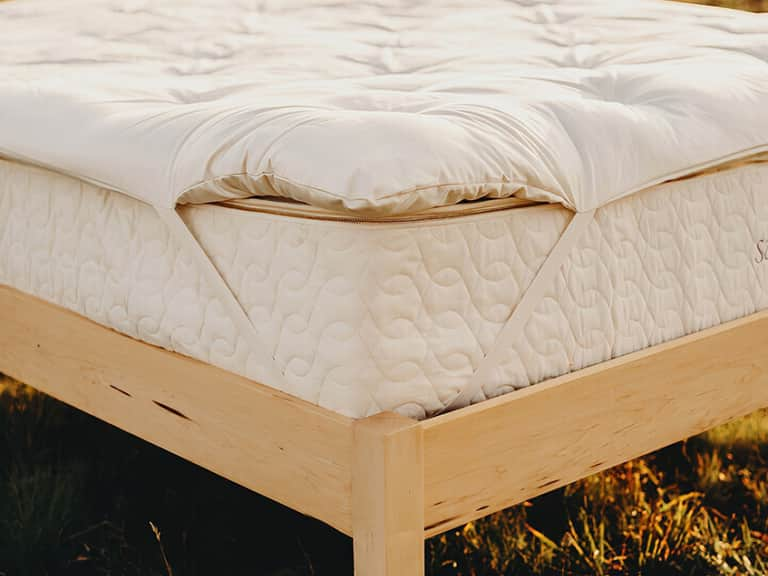
Do not confuse a mattress topper with the mattress itself. A topper can change surface softness and add a layer of wool, latex or another material, but it cannot reliably correct a deeply sagging or unsuitable support core. As an example of a distinct bedding layer, the Savvy Rest Natural Savvy Woolsy Mattress Topper is described as a wool-filled topper with an organic cotton cover. Its materials may be relevant to someone exploring wool bedding, but it remains a topper, not a complete mattress or proof about the construction of the bed beneath it.
Comparing Obasan and Naturepedic with a consistent framework
Brand names can help organise a search, but they should not do the work of product research. Obasan and Naturepedic each offer products described in relation to natural or organic materials, yet a comparison should be made model by model. Product ranges can include different constructions, firmness choices and certification claims; those details may also change over time.
For each model under consideration, collect the same information in one place:
- Layer-by-layer materials: Record the cover, quilting, comfort materials, support core, barriers and joining methods.
- Claim boundaries: Note exactly which materials or finished-product components are certified, and which are not.
- Verification: Identify the certifier and confirm the current scope of each certificate or test.
- Comfort configuration: Compare firmness options, layer thicknesses, zoning and whether components can be changed.
- Care and durability: Check rotation requirements, cover care, repair options, warranty terms and expected service life.
- Practical fit: Consider mattress dimensions, bed-base compatibility, delivery access, trial terms and local after-sales support.
This approach avoids false equivalence. One model may emphasise a particular fibre or modular design, while another may use a different combination of latex, cotton, wool or springs. Rather than assuming that a brand’s overall identity applies equally to every model, compare the documents for the precise product you might buy. If a materials list is incomplete, ask the manufacturer or retailer to clarify it in writing.
For UK readers, also confirm that sizes, delivery arrangements, return conditions and consumer terms apply to the UK market. Product standards, labels and customer protections can vary by jurisdiction and sales channel. A certification’s international reach does not remove the need to understand the terms of the local purchase.
A practical checklist before choosing
Keep the investigation straightforward. You do not need to become a materials scientist to ask useful questions. Begin with what matters to your comfort, then verify the claims that affect your decision.
- Define your needs. Consider sleeping position, preferred firmness, temperature comfort, movement, allergies and any mobility concerns.
- Read the full specification. Look for a layer-by-layer account rather than a short headline description.
- Separate material origin from performance claims. Organic status, breathability, durability and emissions are different questions, each requiring relevant evidence.
- Check certifications at source. Verify the specific product or material, the issuing organisation and the current validity of the claim.
- Ask about the less visible parts. Clarify adhesives, barriers, finishes and any materials not named in the main description.
- Test the comfort terms. Understand the trial period, return costs, collection arrangements and conditions before ordering.
- Plan for care. Follow the maker’s instructions for rotation, airing, cleaning and protective layers. Avoid assuming a mattress is washable.
- Compare the whole cost of ownership. Include delivery, suitable foundations, accessories, maintenance and the likely lifespan—not only the initial price.
Protection and care are part of the sleep surface
The mattress does not meet the sleeper alone. Sheets, protectors and toppers form an additional interface that can influence feel, moisture management and maintenance. A protector may help limit stains and everyday wear, but its performance depends on construction and fit. A waterproof barrier, for example, serves a different purpose from a breathable, non-waterproof cotton or wool layer. Read the description carefully and consider whether protection, temperature preference or easy laundering is the priority.
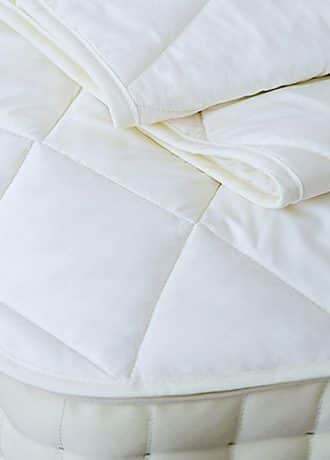
One example of a bedding accessory is the Vispring Lux Skirted Mattress Protector, described with a cotton outer, British wool filling and a fitted design. These details concern the protector, not the certification or composition of the mattress under it. That distinction matters: a certified or natural bedding layer cannot change the material history of the mattress it covers.
Care instructions are equally concrete. Natural fibres can respond differently to washing, heat and moisture, and many mattress components are not meant to be laundered at home. Use a protector that fits securely, follow the manufacturer’s care directions and allow bedding to dry fully. Good maintenance can preserve a clean, comfortable surface, but it should not be presented as a guarantee of a particular lifespan.
The balanced meaning of “organic”
An organic sleep surface is best understood as a set of documented material choices, not a promise that one product will solve every sleep problem. Organic fibres may appeal to people who want traceable sourcing or particular agricultural standards. Natural materials can have useful physical qualities, but their performance varies with design and personal preference. A certification can support a specific claim, while leaving other questions unanswered.
The strongest comparison combines three kinds of evidence: a transparent bill of materials, independent documentation for the claims that matter, and a construction description detailed enough to explain how the mattress works. Then add the human test: does the mattress feel comfortable and supportive for you, in your own sleeping position, over a reasonable trial?
Look closely, ask precise questions and keep the boundaries of each claim in view. A label is a starting point. The layers beneath it—and the evidence attached to them—tell the fuller story.
Frequently asked questions
Does “organic mattress” mean every part is organic?
No. The term may refer to particular fibres or components rather than the complete mattress. Check which layers are covered by certification and whether the core, barriers, finishes and joining materials are separately described.
Is a natural mattress automatically chemical-free?
No. “Natural” does not mean the absence of chemicals, and “chemical-free” is not a useful literal description of a physical product. Ask what materials and treatments are used, and look for relevant testing or certification supporting specific claims.
Are wool and latex always cooler than synthetic foam?
Not necessarily. Temperature experience depends on the complete construction, the sleeper, the bedding and the room. Wool can help manage moisture, and latex has a different feel from many foams, but neither material guarantees a cool night for every person.
How should I compare two organic mattress brands?
Compare individual models using the same checklist: exact layers, certification scope, construction, firmness options, care requirements, trial terms and warranty conditions. A brand’s general reputation does not replace product-specific documentation.